

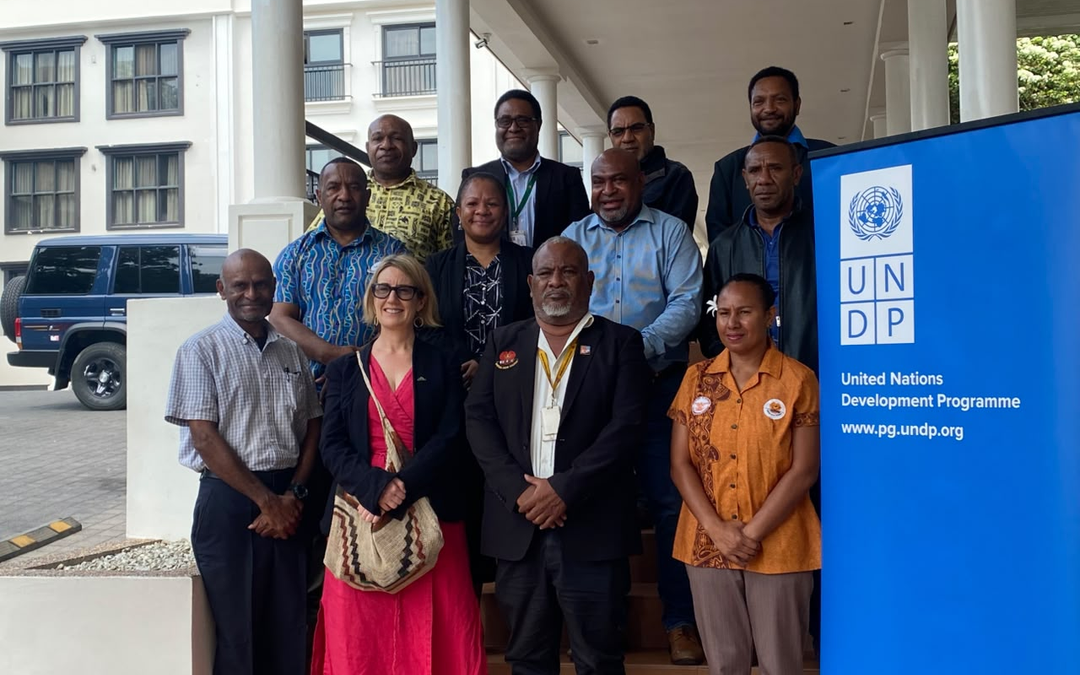
The Department of Information and Communications Technology (DICT) has called for proper management and sharing of government information as work progresses on establishing a National Risk Registry (NRR) for disaster risk management in Papua New Guinea.
The proposed registry will bring together disaster-related information held by different government agencies to help authorities identify risks, plan for disasters and improve preparedness and emergency response.
DICT’s Acting Executive Manager for Data Governance, Ms Nancy Kanasa, spoke about the Department’s National Data Governance and Data Protection Policy 2024 and the proposed Data Governance and Data Protection Bill 2026 during the Workshop on Establishment of the National Risk Registry for Disaster Risk Management in Papua New Guinea.
The policy provides guidelines for how government agencies collect, store, use, protect and share information. It sets out the responsibilities of institutions in managing government data and protecting personal information.
Ms Kanasa also discussed the proposed Bill, which is intended to establish a legal framework for data governance and protection in Papua New Guinea. It covers individual privacy rights, the responsibilities of organisations handling data, data security and the sharing of information between government agencies.
The stakeholder consultation process for the draft Bill has been completed, and the legislation is now going through further work towards finalisation and submission to Parliament for consideration.
The policy and proposed legislation are relevant to the National Risk Registry because the platform will depend on information being shared between different government institutions. Agencies will need to follow clear rules on how data is collected, accessed, used and protected.
The workshop brought together government agencies, development partners and technical representatives to discuss the establishment of the registry. Discussions covered existing data sources across government, agency responsibilities, operational needs and technical requirements for the proposed system.
Participants also reviewed the membership and Terms of Reference of the National Disaster Risk Management and Mitigation Sub-Committee. It was recommended that agencies responsible for data governance, statistics and information management, including DICT and the National Statistical Office (NSO), be represented in the process.
The United Nations Satellite Centre (UNOSAT) presented a proposed system design that would bring together information on natural hazards, exposed people and infrastructure, vulnerable communities, and disaster-related losses and damage.
The registry is expected to support risk assessments, mapping, dashboards and alerts, giving national and provincial authorities access to information for disaster planning and response.
DICT’s role in the process relates to how information from different government agencies will be managed, shared and protected. Proper data governance will be important to the registry’s operation and the responsible use of information held by government institutions.
The workshop was supported by the Government of Papua New Guinea, United Nations Development Programme (UNDP), UNOSAT, United Nations Institute for Training and Research (UNITAR) and the Australian Government Department of Foreign Affairs and Trade (DFAT).