

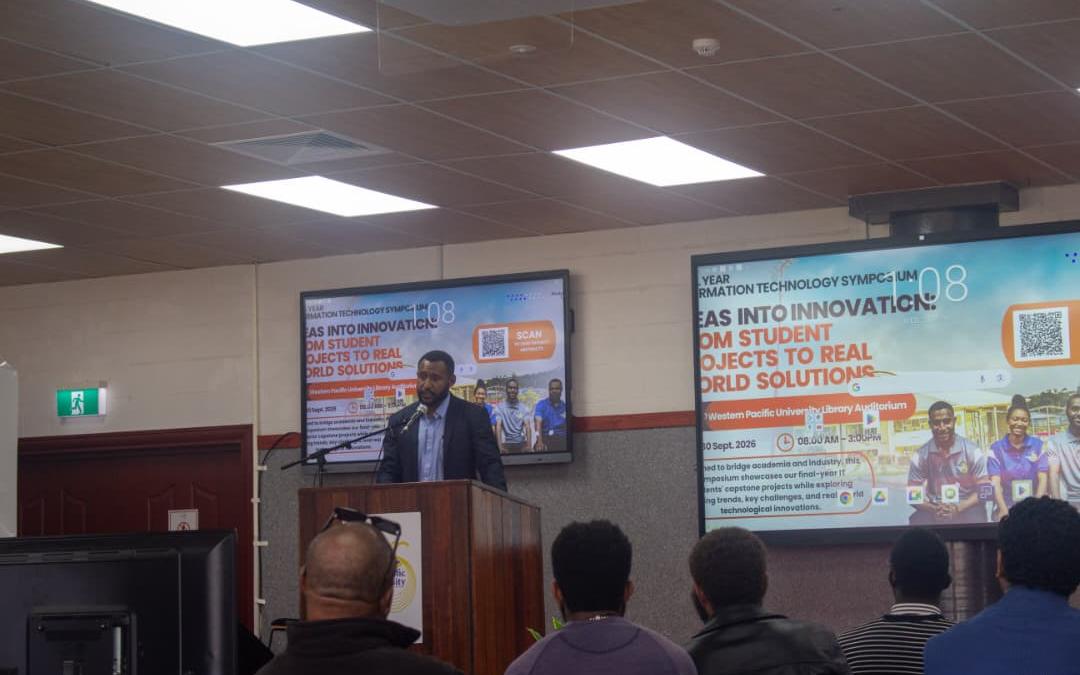
The Department of Information and Communications Technology (DICT) has called on university students to take their technology projects beyond the classroom and build solutions that respond to the needs of Papua New Guineans.
The call came from DICT Acting Manager for Innovation and Stakeholder Engagement Glenn Bireo, who represented Secretary Steven Matainaho at Western Pacific University’s (WPU) Final Year IT Symposium on Wednesday.
The symposium was held under the theme, “Ideas Into Innovation: From student projects to real-world solutions.”
The theme points to the need for students to connect what they learn at university with problems faced by communities, businesses and the country.
WPU students have already put their skills to the test at national level.
At this year’s National Digital ID Hackathon, WPU team CyberPro Netz, made up of Rialisa, Jonathan, Gillion and Vincent, took first place in the Higher Education Institution Track.
Another WPU team, Stax, comprising Avaneesh, Hazel and Shaquille, was the highest-scoring technical team.
Their performance shows the level of technical skills being developed by students and how university projects can grow into working digital products.
DICT has also signed partnerships with universities around Papua New Guinea, including WPU, to give students a closer link to the technology sector and the work being carried out in the digital space.
One initiative being planned is a National Digital Public Infrastructure Centre of Excellence, which would involve universities in developing and testing digital solutions.
The proposed centre would draw on projects from the National Digital ID Hackathons and give selected graduates an opportunity to continue working on their ideas after completing university.
This could include training, technical support and resources to help students turn prototypes into minimum viable products and eventually take them to the market.
Bireo also spoke about the need for trust when developing digital systems.
As more government and other services move online, people need confidence that their information is protected and that the systems they use are secure.
Bireo has been part of the technical team working on the Government Cloud and SevisPass ecosystem and encouraged students to develop technology that understands the needs and circumstances of Papua New Guineans.
“We need Papua New Guineans who can walk the talk,” he said.
“We need Papua New Guinean innovators who understand our problems. We need Papua New Guineans who build solutions that fit our context.”
The symposium gave final year IT students a chance to present their projects and show how their skills could be used to address issues in areas such as business, education, agriculture and community services.
WPU Vice President Academic Affairs Professor Ludmilla Salonda said the university had continued to expand its technology programmes since the IT programmes were first developed in 2021.
She said the university now had programmes covering computing, emerging technologies and cybersecurity, with its first Cybersecurity students expected to graduate next year.
Prof Salonda encouraged students to see their projects as more than university assignments and to keep working on their ideas after graduation.
The event saw students, academics and representatives from the technology sector share ideas on the role of young Papua New Guineans in developing the country’s digital future.